

One diagnosis, said many ways
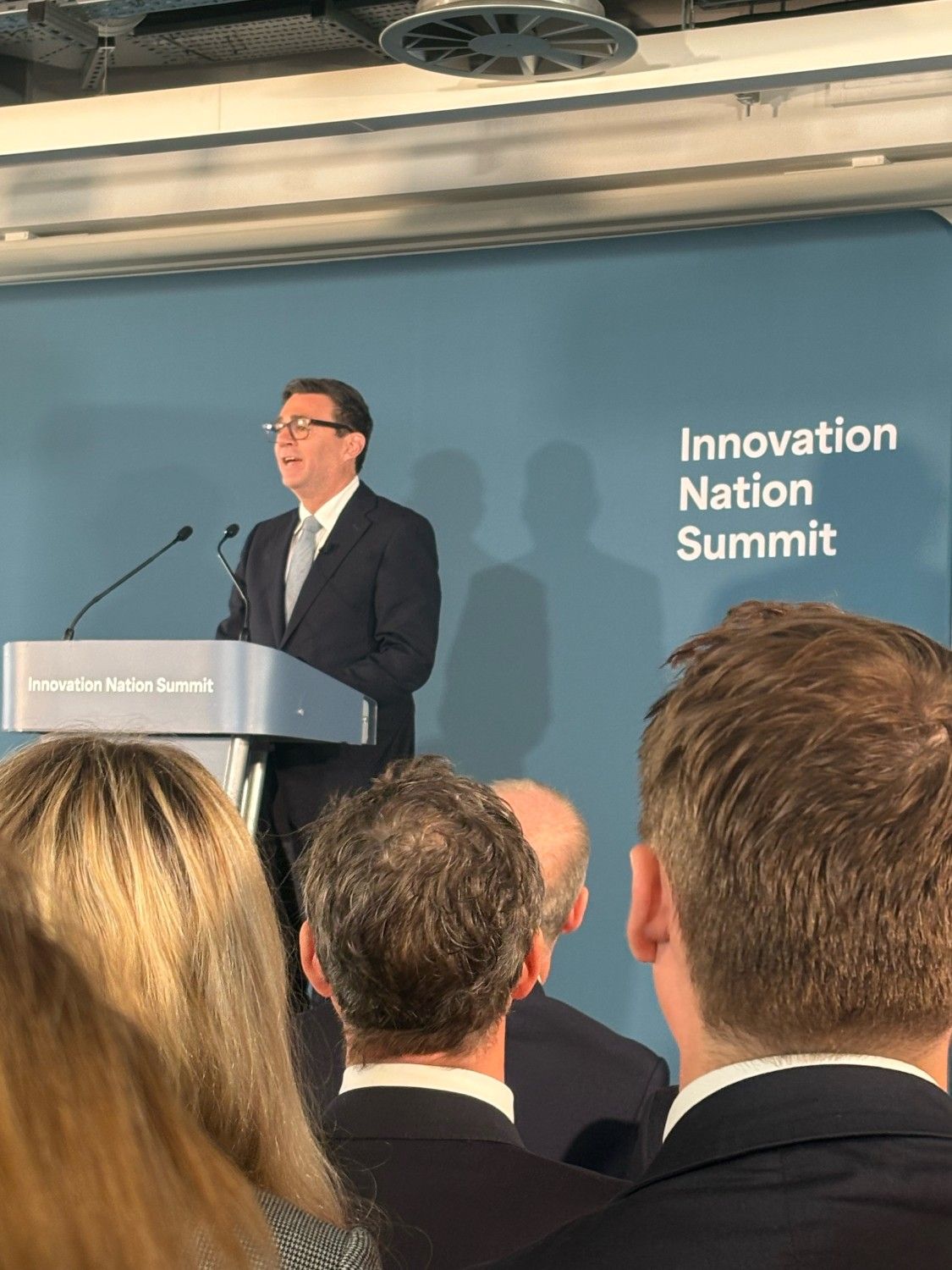
On Friday I was in Manchester for the Innovation Nation Summit, convened by the Growth and Reform Network and hosted by Bruntwood SciTech. Gordon Brown opened the day. The Prime Minister, Andy Burnham, then set a new national goal: for the UK to become the world's leading innovation nation, with a globally significant cluster and a globally significant company in every region and nation.
We also heard from the AI Minister Kanishka Narayan, the Business Secretary Jonathan Reynolds and Bev Craig, Mayor of Greater Manchester, alongside investors, vice-chancellors, scientists and founders.
What struck me was how consistent the diagnosis was. We are not short of ideas or science, and we are very good at starting companies. Where we fall down is keeping them, scaling them and backing them with our own money. Put simply, money is flowing to the wrong places. That is fixable, because it comes down to decisions and policy.
Three places the money leaks
Our pensions
Our pension savings are managed by large institutional investors, the LPs (limited partners) who put money into venture and growth funds. Very little of it backs UK start-ups and scale-ups. One investor on stage pointed out that London has hundreds of venture-backed companies with more than £25m in revenue, and London's local authority pension funds have backed none of them. A life sciences investor said less than 1% of their fund comes from UK pensions, so the returns from British science are paying pensions abroad.
Our risk capital
UK SMEs received £10.8bn of equity investment in 2024, and 61% of it went to London. When companies are ready to scale, the money too often comes from overseas and the company follows it. A vice-chancellor told the room that when a founder holds a British term sheet and an American one, nine times out of ten they take the American. The IP, the talent and the future tax base go with them.
Our public spending
Only 5% of public procurement contracts went to scaling firms in 2024, worth £4.5bn. A government contract is more than revenue. It shows someone has done the due diligence, and it is often what unlocks private investment. One founder said it can be easier for a UK scale-up to sell to a US government department than a UK one. That should never be the case.
Great at discovery, weaker at what comes next
The UK produced 12% of the world's most highly cited research in 2022. That share has fallen 17.6% since 2018, so the direction of travel is wrong, but we are still a major contributor to global science. The problem is what happens after the paper is published.
Speaker after speaker made the same point. Spotting good science is not the hard part. The hard part is adoption: getting new technology, treatments and ideas used by businesses, the NHS and the public sector. The government's own minister was refreshingly candid about this. He said vouchers and management programmes have not shifted adoption at scale, and asked the room for new ideas.
There is real energy coming through. One vice-chancellor said close to half of their students now want to start a business. That is a huge opportunity, but only if we build the pathways, the funding and the local support to keep those businesses here when they grow.
Who gets backed, and where
The summit paper made inclusion one of its five shifts, asking who creates and leads innovation and who shares in the growth. I want that to carry real weight when the plans are written.
Only around 2% of the capital deployed into UK businesses goes to women-led companies. Around 40% of that 2% goes to companies in London. Outside the capital, the figure is close to a rounding error.
That is a waste of talent, and it runs against everything the Prime Minister said about good growth in every postcode. The opportunity outside London is real: Leeds has more fast-growing, venture-backed firms than Oxford. If we want a globally significant company in every region, we have to back the founders already building them there, including the women.
What I want to see next
There was a lot to welcome on Friday. The Prime Minister announced that local innovation funding will be devolved to established mayors from 2028. He committed £1bn over four years, with UKRI, to back clusters that can become world-leading. He also pledged more UK pension capital for British high-growth companies and harder-working public procurement. Those are the right levers. Now they need pace and teeth.
Three fixes would change the flow of money:
- Pensions. Put clear expectations, and if needed mandates, on LPs to invest a meaningful share in UK start-ups and scale-ups, including outside London.
- Procurement. Give public bodies guidance and targets for buying from UK scale-ups, so they get the traction that attracts capital.
- Spinouts and spin-ins. Make it simpler and faster to move ideas and people between universities and industry, and keep the resulting companies here.
The fourth fix is about how we deliver all this. Back the people who are already on the ground solving these problems, rather than starting again.
In Leeds, our AI Lab works directly on adoption, employability and entrepreneurship. We bring students through an education programme and onto real AI projects with businesses, particularly in financial and professional services, so that the adoption curve moves faster.
The Whole Point grew out of a government taskforce I sat on and has been running for three years. It focuses on women-led, high-growth scale-ups, typically turning over more than £1m, employing more than ten people and growing at 20% a year. Our boards in Leeds, Liverpool, Edinburgh, Birmingham and Newcastle exist to get capital to women-led scale-ups in the regions.
Shy bairns get nowt
The UK already sets the standard in research, and the summit showed the ambition is there at the top of government. What we need now is to stop the leaks: pension money going overseas, scale-ups following capital abroad, and public spending that barely touches our own growth companies.
The people and projects to help fix this already exist, in every region. Back them, and the innovation nation stops being a goal and starts being something we can see.
If you want to know more about the AI Lab or The Whole Point, or you're working on the same problems, get in touch. Shy bairns get nowt, so I'm asking.
<em>Statistics on research, capital and procurement are from the summit's conference paper and the Prime Minister's published speech. Panel contributions are summarised without attribution.</em>
About the author

Zandra Moore MBE
Co-founder, AI Lab UK
Zandra co-founded AI Lab UK and champions practical, accessible AI skills for people and businesses across the UK.