
Most universities and colleges now offer their students something on AI. A lunchtime session, an online module, a digital skills badge, a careers workshop with a slide on prompt writing. The intent is right and the delivery is often good.
It is also not what employers are asking for.
The Institute of Student Employers found that 87% of employers expect AI adoption to reshape graduate and apprentice roles, while 43% said their entry-level roles had already evolved in response to AI without being formally redesigned. That second figure is the interesting one. It describes employers who have quietly changed what a graduate does on their first day, but haven't written it down, told anyone, or updated the job description. There is no curriculum you can align to, because the thing you'd be aligning to hasn't been documented yet.
Meanwhile, competition for graduate roles has intensified sharply. The Institute of Student Employers reported an average of 140 applications per graduate job, a 59% increase on the previous year and the highest level recorded since it began tracking the data in 1991.
Put those together and a student's problem becomes clear. They are applying to a role that has changed in ways nobody has described, against nearly twice the competition of three years ago. A certificate saying they attended an AI awareness session does very little in that situation, because so did everyone else.
What actually differentiates a candidate
There's a useful piece of research on this. AI Skills for the UK Workforce, written by Dr Nisreen Ameen of Royal Holloway and published via gov.uk with Skills England, sets out an AI Skills Framework mapping three kinds of skill across job levels: technical, responsible and ethical, and non-technical. It also finds that AI adoption and skills needs vary sharply by sector, organisation size and location, and identifies structural barriers to upskilling.
For most roles, the second and third categories matter more than the first. And that's the distinction that matters for an employability programme, because those are the hardest things to teach in a session. Knowing whether an output can be trusted. Whether using a tool on this particular data is defensible. Whether the answer is worth acting on at all. That's judgement, and judgement only becomes visible when someone applies it to a problem where being wrong has a consequence.
The market has already put a price on it. PwC's 2026 UK AI Jobs Barometer found an average AI wage premium of 34.2% in 2025, up from 11% the previous year. It also reported that UK job postings requiring specialist AI skills increased from 112,000 to 180,000, returning demand to levels last seen in 2022. That's not a premium on AI awareness. It is a premium on people who can turn AI capability into useful work — people who can be handed an ambiguous business problem and come back with something usable.
The same report describes a two-track labour market: roles where AI amplifies expertise are growing in value, while roles where it simplifies tasks are becoming more accessible but growing more slowly. Your students are choosing a track, mostly without knowing it. The thing that moves them onto the first track is evidence of judgement, not evidence of attendance.
The gap in most employability provision
The gap looks like this. Most AI provision in education gives students:
- Understanding of what the technology does
- Familiarity with a few tools
- A credential confirming they turned up
What it rarely gives them:
- A real organisation's problem, with real constraints and real ambiguity
- The experience of narrowing a vague problem into a specific opportunity
- A judgement call about which opportunity is worth pursuing, and why
- Something they built, that a business looked at and responded to
- A story with a real difficulty in it
The second list is what an interview actually tests. "Tell me about a time you had to work out what the problem was" is a standard competency question, and an awareness course gives a student nothing to answer it with.
None of this is a criticism of the provision. It's a structural constraint: you cannot manufacture a real business problem inside a curriculum, so you have to go out and get one.
How AI Lab UK closes it
AI Lab UK is a challenge-led AI capability bridge. The mechanism is straightforward: businesses bring real problems, education partners bring learners, and learners work the problem using the Zygens framework.
A student moves through six stages:
- Discover — what AI can and cannot do, and where it's already changing work.
- Identify — find the AI opportunities inside a real organisation's workflows, pain points and bottlenecks.
- Prioritise — build a ranked use-case backlog, assessing value, feasibility, risk and complexity. This is where judgement gets built, because prioritising means defending why one thing matters more than another.
- Create — produce something practical: an agent prototype, a workflow concept, a process map, a business case.
- Apply — do it on an actual organisational challenge, not a case study.
- Progress — use the experience and outputs to move into employment, placements, apprenticeships or further study.
The pathway is level-adjusted rather than split. A sixth-former and a final-year student follow the same six stages at different depths, which means a partner institution isn't buying a bespoke programme.
The student finishes with a prioritised use-case backlog, a prototype and a business case that a real organisation has seen. That is a portfolio, a set of interview answers, and evidence of judgement applied under real constraints.
What the partnership looks like from your side
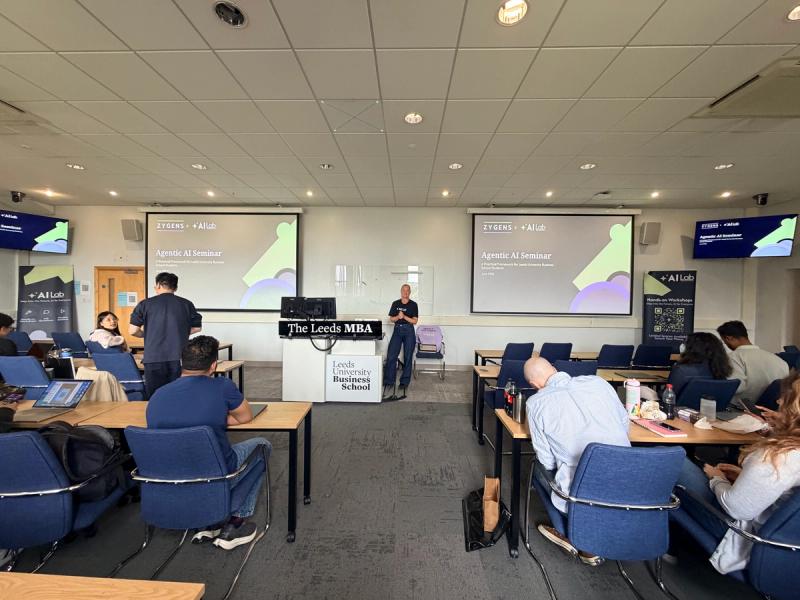
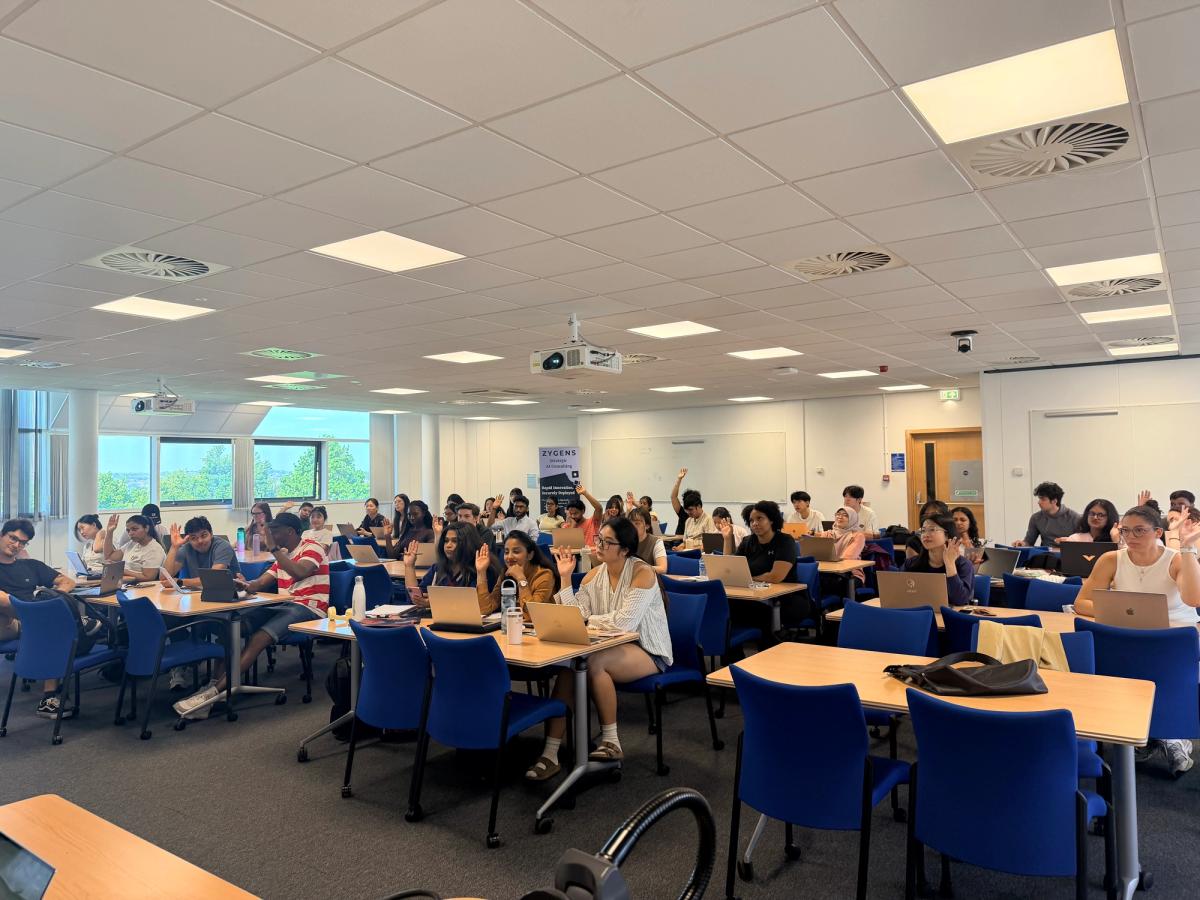
The Leeds model has produced:
- 400+ students trained
- 100% of participants receiving certificates
- Around 5% of trained students going on to become volunteers — returning to support delivery, which is a stronger engagement signal than any satisfaction score
- 150 members of the public trained with student support — students teaching what they learned, which is where confidence becomes visible
- Venue sponsorship via Trinity Leeds, and funded workshops and bootcamps supported by the University of Leeds
- CPD accreditation currently in progress
For an institution, the practical appeal is that most of the hard parts sit outside your operation. AI Lab UK sources the business challenges, convenes the delivery, and brings the Zygens framework and facilitation. Corporate sponsorship helps fund regional delivery, venue access and learner participation, which keeps the cost of taking part low for the institution.
What we need from a partner is access to learners, and a route into the local employer relationships you already hold.
What you get back is employability outcomes with artefacts attached, and employer engagement that goes past a logo on a slide. It also counts as civic impact you can evidence, which matters given West Yorkshire's position. Over 80% of jobs in the region require essential digital skills while 15% of residents lack those skills, and West Yorkshire is recognised under the UK Government's High Potential Opportunities programme as a world leader in data and AI. The regional ambition is there. The delivery mechanism connecting learners to real employer problems is the part that's thin.
Two things this isn't
It isn't a replacement for your curriculum. It sits alongside it, in the space between what a course can teach and what an employer will ask for.
And it isn't finished. We're building the business challenge pipeline, pursuing CPD accreditation, and codifying the Leeds model so it can be replicated properly rather than approximately. We'd rather say that plainly than describe a mature national programme.
What we do know is that the model works where we've run it, and that the gap it addresses is getting wider, not narrower. Every cohort that leaves with awareness but no evidence enters a market where employers increasingly reward judgement, application and proof of capability. Awareness may get attention. Evidence gets opportunities.
If you lead employability, careers, or industry engagement at a university, college or sixth form, we'd like to talk. The first conversation is 30 minutes and covers what your learners currently get, where the evidence gap sits, and whether a pilot cohort makes sense.
AI Lab UK and Zygens
AI Lab UK is the ecosystem: the community, education partnerships, business challenge pipeline and regional delivery model. Zygens is the framework: the practical method participants use to identify AI opportunities, prioritise use cases, design agents and build business cases. AI Lab UK is funded through sponsorship and education partnerships. Zygens is a commercial company and provides the framework that AI Lab UK delivery is built on.
Sources
- Institute of Student Employers — Entry-level work reshaped not replaced: https://ise.org.uk/knowledge/insights/562/entrylevel_work_reshaped_not_replaced/
- Institute of Student Employers — Record graduate job applications: https://ise.org.uk/knowledge/insights/410/record_graduate_job_applications
- AI Skills for the UK Workforce — GOV.UK: https://www.gov.uk/government/publications/ai-skills-for-the-uk-workforce/report-overview
- PwC UK AI Jobs Barometer 2026: https://www.pwc.co.uk/services/technology/generative-artificial-intelligence/uk-ai-jobs-barometer.html
- West Yorkshire Local Growth Plan — Priority Three: https://www.westyorks-ca.gov.uk/resources/local-growth-plan-priority-three/
- Local Growth Plan Priority Three — WYCA: https://westyorks-ca.gov.uk/growing-the-economy/economic-strategy/local-growth-plan/priority-three-a-region-of-learning-and-creativity
About the author

Charlie Bartle
Co-founder, AI Lab UK · CIO, Zygens
Charlie co-founded AI Lab UK and runs the lab programme on the ground. He works with SMEs, councils and universities to turn AI curiosity into working tools people actually use.