
By Charlie Bartle and Zandra Moore MBE
UK businesses have never been more aware of AI. Almost none of them have scaled it, governed it, or measured what it returned. That distance is where the value is being lost — and it is not a skills problem.
Thousands of people in this country have now completed an AI awareness course. Thousands more have a Copilot licence, a ChatGPT tab open, and a reasonable working sense of what a large language model does and doesn't do.
Ask those same organisations a different set of questions and the confidence disappears:
- Where should we start?
- What should we automate first, and why that?
- Who owns it once it's live?
- What happens when it gets something wrong?
- How will we know if it worked?
Those are not literacy questions. No amount of awareness training answers them. They are capability questions, and they are where most organisations are currently stuck.
The UK has a capability challenge, not an awareness problem
The evidence on this got a lot clearer in the last fortnight.
The Office for National Statistics reported in July that self-reported AI use among UK businesses with ten or more employees has risen from around 12% to around 35% since late 2023 — close to tripling in under three years. Awareness and access are not the bottleneck. But of those businesses using AI, only 10% describe themselves as using it extensively. And only 11% report that more than half of their workforce has received AI-related training.
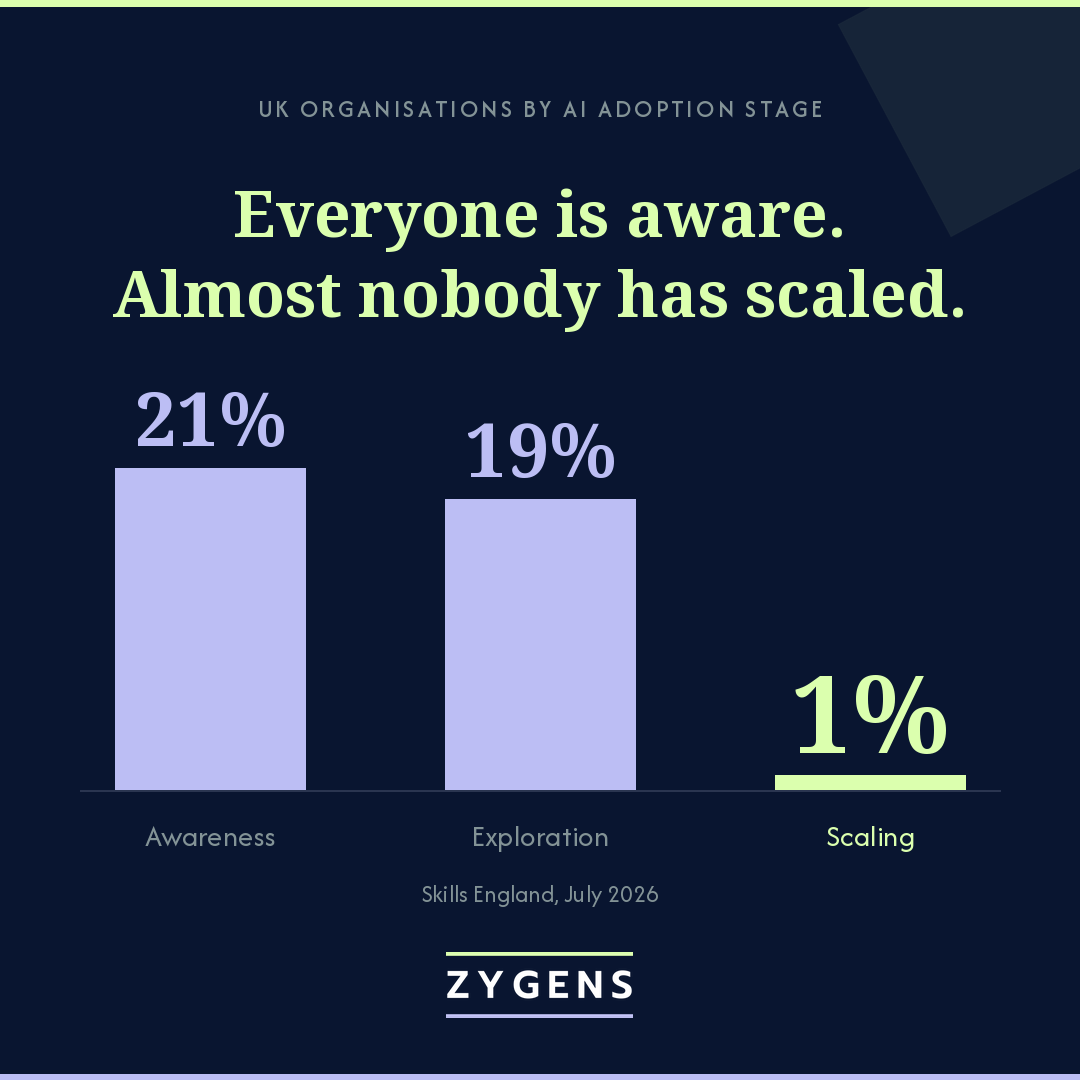
The picture from Skills England is sharper still. Its July 2026 insight briefing on AI upskilling found that more than 44% of organisations now use AI tools daily — and that over 40% of organisations remain in the earliest stages of adoption, split between awareness (21%) and exploration (19%).
One number matters more than the rest: 1% have reached scaling.
That is the whole argument in a single figure. Adoption of AI tools is now mainstream. Adoption of AI as something an organisation can run, govern, and account for is almost nowhere.
AI awareness tells people what AI is. AI capability helps an organisation decide what to do with it, and then actually do it.
Why training alone isn't enough
The distinction matters, because "skills" is doing too much work in the current debate.
Knowledge is understanding what a model does, knowing the terminology, recognising where hallucination risk sits, being able to write a decent prompt.
Capability is being able to look at a real process, identify where value is trapped, judge whether AI is the right instrument, assess the data and regulatory exposure, decide who is accountable for the outcome, build the thing, and prove whether it made a difference.
Training reliably produces the first. It rarely produces the second — and, importantly, the UK's own framework says so.
The AI Skills for Business Competency Framework, sponsored by DSIT and funded through Innovate UK's BridgeAI programme, is now on version 3. It is a serious piece of work: six personas, 41 duties, 92 competencies, mapped against proficiency levels and an embedded project lifecycle. Anyone designing an AI skills programme should read it.
And inside it sits the most important sentence in the UK AI skills debate. The framework, it says, "signals which KSBs can be developed through training or self-study, and which (for example, those involving leadership, accountability or stakeholder engagement) must be acquired through practice in real situations."
“The framework signals which KSBs can be developed through training or self-study, and which (for example, those involving leadership, accountability or stakeholder engagement) must be acquired through practice in real situations.”
Read that again. The national competency framework states plainly that a whole category of AI competence — the accountability and judgement half — cannot be taught in a classroom. It has to be built by doing the work.
That is not a criticism of the framework. It is the framework being honest about its own limits. A framework describes a destination. It is not a vehicle.
You can see the consequence in almost any mid-sized business. A 60-person professional services firm sends its managers on an AI awareness day. Everyone comes back energised. Six weeks later there are fourteen individual Copilot habits, no shared view of which processes matter most, one partner quietly pasting client data somewhere they shouldn't, and nobody who can say what the firm's AI position actually is. Nobody failed. The training worked. It just wasn't the thing that was missing.
The gate
Between "we understand AI" and "AI is delivering value here" sits a process most organisations have never been given. Reduced to its bones, it has four stages: Discover the opportunities inside real workflows, Design the solution and decide what is worth building, Develop it with guardrails, Deploy it into the workflow rather than alongside it.
The four stages are not the interesting part. Every credible methodology converges on some version of them — the AI Skills for Business framework sets out its own lifecycle from framing through to operation, Skills England's PRIMES principles point the same way. The sequence is not the scarce thing.
The scarce thing is what happens at the gate between the first two stages.
Discovery is the easy half, and the enjoyable half. Put a room of people who know the work in front of a whiteboard and you will have thirty candidate use cases by lunchtime. Then someone has to pick two and justify that choice to a board.
This is where organisations stall, and not for want of ideas. The ideas arrive as stories rather than investable propositions. A complaint-triage agent, a broker-reporting agent and a training assistant land on the same agenda with no shared measure between them. Nothing can be compared, so either nothing gets funded or the loudest advocate wins. Meanwhile the number the board actually owns — profit — never enters the conversation.
That gate is where the 1% gets decided. And it is a governance problem wearing the costume of a technology problem.
The obvious objection
There is a fair challenge to all of this, and it comes from the government's own research, so it deserves an answer rather than a sidestep.
Skills England found that the binding constraint on AI upskilling is not awareness or perceived value. It is capacity: lack of protected time, limited staff availability, and affordability. Employers' most-wanted enablers were flexibility (50%), cost (46%), and staff capacity (44%).
So telling a business that can't spare its people for an afternoon to adopt a structured capability process is not obviously helpful. It sounds like more overhead.
That objection is right, and it disciplines the answer. A capability layer that arrives as a separate programme — its own meetings, its own deck, its own workstream — will be abandoned by exactly the organisations that need it most. It only works if it is embedded in real work rather than added alongside it, and if the first cycle produces something the business can use rather than a maturity score.
It also means the method matters less than whether anyone can afford to reach it. Those are two different problems, and they need two different answers.
Getting the gate right: the methodology
We work on both halves. Zygens is the methodology and the platform. AI Lab UK is the delivery vehicle that makes it accessible through challenge-led learning. One answers how the decision gets made. The other answers who gets to make it.
The methodology first, briefly, because the detail is only interesting insofar as it shows the gate can be closed.
Zygens scores every candidate use case through a framework called VECTOR: Value, Evidence, Complexity, Time criticality, Objectives and Risk. Value resolves into four measures a finance director already owns — new revenue won, revenue retained, hours released, and supplier or rework spend removed. Objectives forces every use case to point at a target the organisation has already committed to, rather than at AI as its own justification.
The input that does the most work is Evidence. Every claim attached to a use case is tagged as Asserted, Modelled or Evidenced, and priced accordingly. Someone's confident estimate is not treated as equivalent to a measured result. It stays visible, because early strategic bets shouldn't be filtered out for being early — but it stays cheap until the evidence catches up.
That single discipline is most of the difference between a use-case pipeline and a portfolio of pilots that never proved anything. AI business cases usually fail not because the technology didn't work, but because nobody wrote down in advance what would have counted as proof. Everything then reports against one number: how far AI widens the gap between revenue growth and cost growth. Not an AI maturity score. A ratio the CFO already tracks.
That is the mechanism. On its own, it is available to organisations that can commission it — which is a fraction of the economy, and not the fraction with the biggest capability gap.
Making it accessible: challenge-led learning
Which is the problem AI Lab UK exists to solve.
AI Lab UK is not a training provider, a consultancy, an events business, or a meetup group. It is the delivery vehicle for the same methodology, built to reach people and organisations that would never appear on a consultancy's client list: students, school leavers, graduates, career changers, SMEs, members of the public.
The design principle is that people learn the method by using it. Learners are taught elements of the framework itself rather than a syllabus about AI — how to find where value is trapped in a workflow, how to weigh options against each other, how to argue for one. The pathway is built to carry real organisational challenges, because the national framework already explained why it has to. You cannot lecture someone into accountability or stakeholder judgement. You put them in front of a real problem, a real constraint and a real deadline, and let the competence form where competence actually forms.
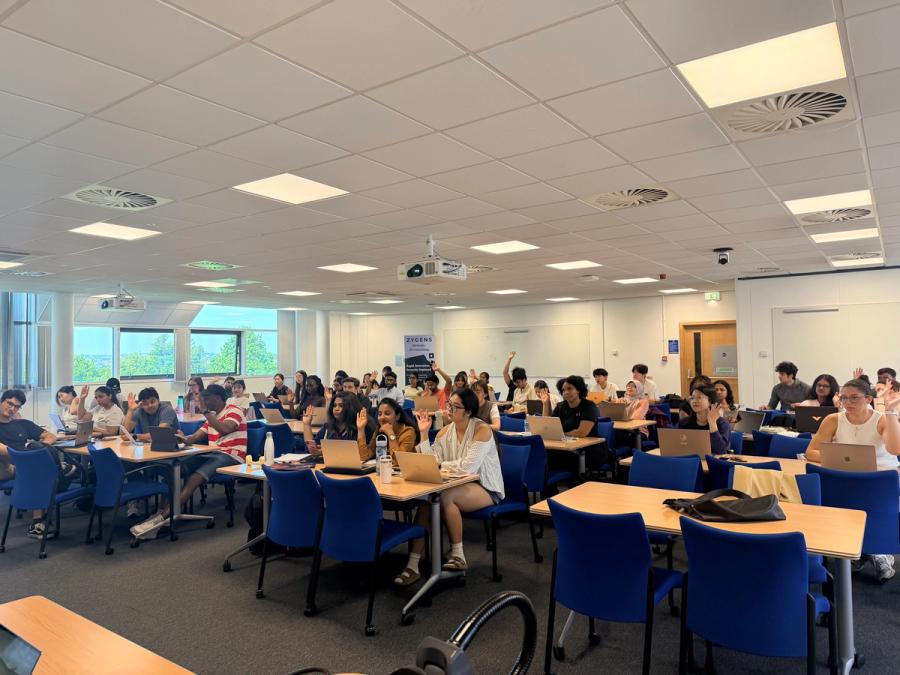
What we have proven in Leeds so far is the flywheel that makes this work at any scale. Over 400 students have been trained through the model, supported by funded workshops with the University of Leeds and venue sponsorship from Trinity Leeds. Around 5% of those trained have gone on to volunteer and help deliver sessions to others — including 150 members of the public taught with student support.
That volunteer loop matters far more than the headcount. Attendance tells you people turned up. People choosing to come back and teach the method to someone else is the clearest signal available that capability transferred rather than information.
It also changes the economics, which is the part that turns out to matter most.
Why ecosystems matter
Capability has never been built by modules. It develops through communities, collaboration, challenge-solving, experimentation and mentoring — the way every other professional competence has ever formed. Nobody became a competent accountant, engineer or nurse purely by completing courses. It is strange that AI, of all things, was expected to be different.
That is the philosophical case. The practical case is about unit cost, and it is more persuasive.
The dominant model for building organisational AI capability is consultancy. It works. It also transfers capability to one organisation at a time, at a price point that excludes most of the UK economy. Every engagement starts near zero: the learning from the last one stays with the firm that sold it. For a FTSE company with an innovation budget, that is a reasonable trade. For the 60-person professional services firm, it is not a trade that is ever offered.
An ecosystem has a different cost curve. When universities, colleges, employers, sponsors, local authorities and community organisations are connected around real challenges, the cost of each learning cycle is spread rather than repeated, and the output of one cycle becomes the input to the next. When 5% of the people you train come back to teach, the marginal cost of the next hundred learners is not the same as the cost of the first hundred. Capability compounds instead of resetting.
That is why regional AI capability is starting to look less like a skills initiative and more like economic infrastructure — closer to broadband than to a course catalogue.
In West Yorkshire the arithmetic is already uncomfortable. More than 80% of jobs in the region require essential digital skills, and 15% of residents don't have them. At the same time the region is recognised under the UK Government's High Potential Opportunities programme as a world leader in data and AI. Both things are true simultaneously: real strength at the top, a sizeable excluded population underneath. That is precisely the shape of problem an ecosystem is good at and a procurement exercise is not. The Local Growth Plan and the Digital Blueprint name the ambition clearly enough — skills, jobs, productivity, digital inclusion, inclusive growth. What they are short of is delivery mechanisms.
And it determines who gets access. Large organisations will build AI capability regardless; they have the budgets and the innovation functions. SMEs, students from non-traditional backgrounds, and people already excluded from technical education will only get there if something is deliberately built to include them. Ecosystems do that. Individual training contracts and consultancy engagements, by their structure, cannot.
From competency frameworks to capability infrastructure
The UK now has a genuinely good competency framework. It describes what people should know, what they should be able to do, and how accountability should be distributed. That is real progress and the people who built it deserve credit.
But a framework is a specification, not a machine. It tells you what competence looks like. It doesn't run your discovery process, hold your risk decisions, or tell you which of your thirty ideas to build first.
Government has set a target of upskilling ten million workers in AI. Hit that target with awareness training alone and the 1% scaling figure will barely move. You would have ten million people who understand AI and roughly the same number of organisations that still cannot answer "who owns this?"
So the work in front of the country is not more training, more awareness or more events. It is the unglamorous business of building capability infrastructure: the methods that let organisations decide well, and the ecosystems that put those methods within reach of people and businesses who will otherwise be left to work it out alone. Methods without access reach the organisations that were always going to be fine. Access without method produces enthusiasm and not much else.
We are building one contribution to that, in one region, and we would rather it were one of many. Universities, colleges, employers, sponsors and combined authorities all hold a piece of this that we do not. The regions that treat AI capability as infrastructure — something built deliberately, shared widely and measured honestly — will be the ones where the 1% figure starts to move.
Frameworks describe capability. Something has to generate it.
Calls to action
AI Lab version: Want to build practical AI capability through real-world challenges? Join the AI Lab community.
Zygens version: Want a structured way to move from AI ideas to governed implementation? Explore the Zygens platform.
About the author

Charlie Bartle
Co-founder, AI Lab UK · CIO, Zygens
Charlie co-founded AI Lab UK and runs the lab programme on the ground. He works with SMEs, councils and universities to turn AI curiosity into working tools people actually use.